

The Conservation – Restoration of artworks is to safeguard a common cultural heritage in order to transmit it to future generations and to preserve it in the best possible conditions.
This effort by the conservation-restoration is based on 3 fundamental foundations
The preventive conservation
Includes all indirect measures and actions aiming at avoiding and minimising future deteriorations or loss of any art object. This happens i.a. by establishing appropriate conditions and methods for the artworks storage, packing, transportation, handling, and display.
The remedial conservation
Comprises all direct measures applied to the cultural item stopping current damaging processes and reinforcing its structure.
The restoration
Incorporates all operations restoring the objects readability and physic, aesthetic and historic unity, respecting at all moments the original materials.
A close examination and the full comprehension of the item is required in order to draw up the most appropriated treatment protocol.
The following deals with the professions deontology and the examination steps enabling the acquirement of all essential data concerning the artwork.
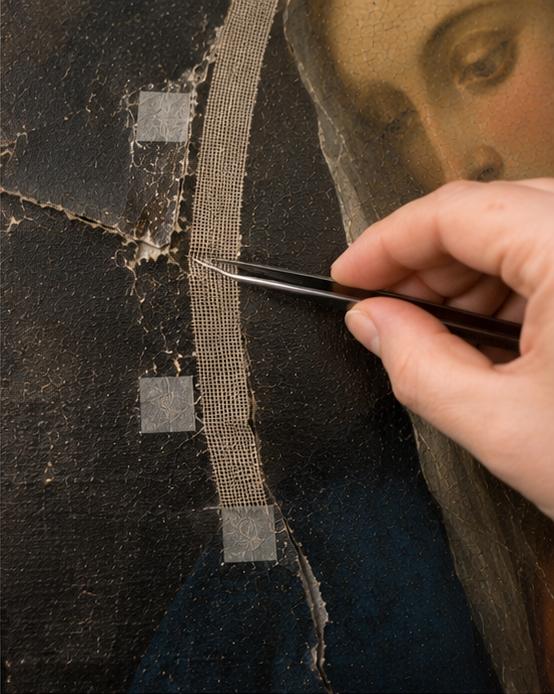
Deontology / Work with ethic
Our approach as well as our actual activity are heavily affected by the respect of the five basic tenets expressed by E.C.C.O in the Venise Charter:
The principle of reversibility of all applied materials during the treatment guarantees the future removal of our operations without damaging the artwork. On that account it is essential that the materials’ nature and sensitivity differs from the artists.
The stability and steadiness of used materials and interventions in view of aging prevent from too frequent treatments.
Innocuousness: no material nor operation should harm or sensitise the cultural goods.
Readability and conspicuousness: the readability of the cultural assets is restored by all actions aiming on the recovering of the artworks harmony and unity. The compensations must be distinguishable from the original areas and must not conceal or cover them.
The transparency is assured by the photographic documentation and the record of all operations.
Condition report
The condition report implies three decisive steps : the identification of the constituent materials, the assessment and examination of deteriorations, and the diagnosis.
The examination of the constituent materials composing the strategraphy of the artwork (auxiliary support, support, prime, ground, paint layer, surface coating, varnish) enables the restorer to identify their specific properties, their interactions, their behavior regarding temperature and moisture change, and in certain cases, the identification of the time of origin.
The assessment of every deterioration allows their analysis and their categorisation according to their cause of apparition, their emplacement and their extent. The principal causes are normally the bad condition of preservation (the location, the climatic conditions, the exhibition), the inadequate handling and the biological hazards (pests, mould).
The diagnosis is a detailed description of the deteriorations, and the behavior of the constituent materials, in order to establish logical connections between them. This procedure permits the understanding of the deteriorations’ apparition, their evolution up to today as well as their future behavior and development if any treatment is planed.
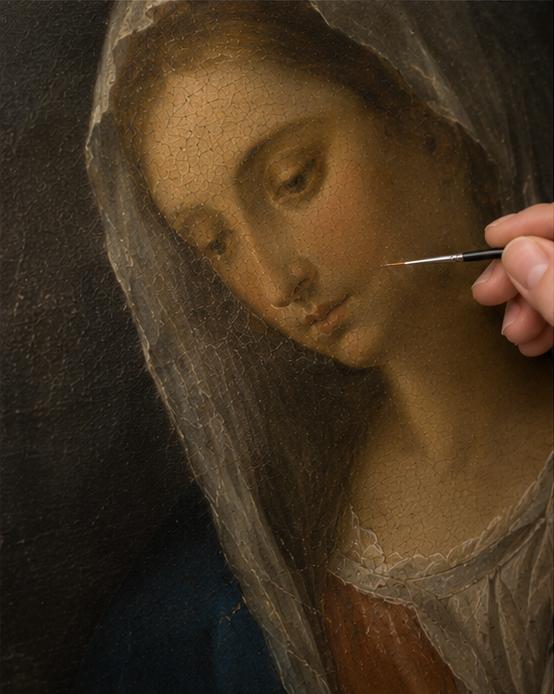
The restoration protocole
The profound analysis of the artwork allows to draw up a treatment protocole, considering the requirements of the painting, its futur site of conservation along with the owners specific requests.
In order to carry out the protocole, this latter has to be accompanied by several pre test, determining the most appropriate product and application method for the surface cleaning, the solubilisation of the varnish coat and more generally the nature of the materials for the restoration.
Every cultural asset is different and needs adequate treatments. A restoration campaign isn’t a harmless action for a painting. In consequence, we have to intervene in a minimal way but nevertheless guarantee a most satisfying result for the painting just as for the client. By this means, the restorer acts as a mediator, finding a solution between the needs of the painting, the demands of the client and the work ethos of the field.
The restoration
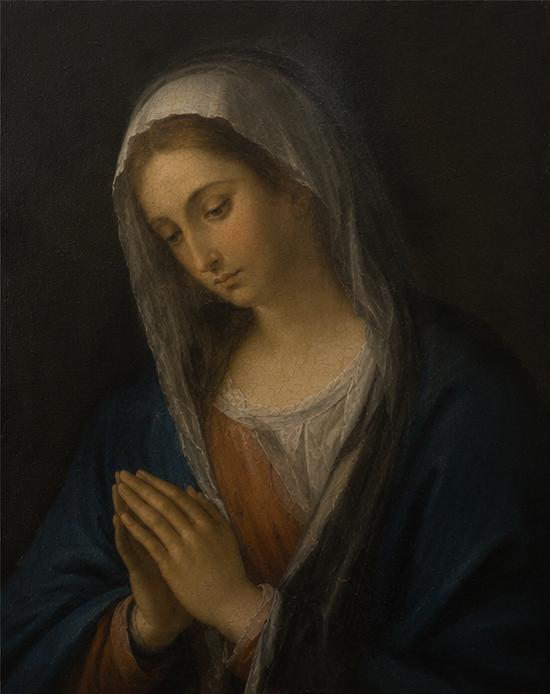
After acceptation of the protocole, we proceed to the restoration work.
The operations are divided into two categories ; the conservatory operations (e.g. the removal of ancient patches producing disastrous tensions), and the restoration interventions : esthetically treatments as the chromatically integration of losses.
A vaste number of operations exists and can be part of the restoration process : facing, refixing in a specific area or in a general way on the backside (the adhesives can be of different nature), surface cleaning, varnish removal, removal of the stretcher/strainer, strip lining, mounting, smoothing out of canvas deformations locally or in a general way by a facing, thread to thread linking, inlays or intarsia , full or partial lining, loose lining, filling, inpainting/retouching, varnishing, removal of the frame, fitting of the frame, restoration of the frame, gilding.